As an Amazon Associate, we earn from qualifying purchases. This doesn’t change our recommendations or the price you pay.
When the grid drops, the best portable power station is the one sized for what you actually need to keep running: a phone and router for an evening, a CPAP through the night, or a refrigerator for a day. Battery stations make no exhaust, so unlike a gas generator they can sit inside the house, and many now switch over automatically when the power cuts out.
We compared seven units from EcoFlow, Jackery, Anker SOLIX and BLUETTI, from a 245 Wh carry-anywhere box to two 2 kWh stations built for fridge backup. Each one is in stock and sold by Amazon.com or the brand’s own Amazon store. We quote capacity, output, recharge times, UPS switchover and battery chemistry exactly as each listing states them, and we flag what the listing leaves out.
Run-time figures in this guide are rough estimates by our math, using a simple formula you can apply to your own devices.
Our Top Portable Power Station Picks at a Glance
| Product | Key features | Price | Action |
|---|---|---|---|
 Anker SOLIX C1000 Gen 2Best Overall · 1,024 Wh, 2,000W ACBest for: Whole-evening backup with very fast recharging |
|
$$$$ | Buy Now →Check current price |
 EcoFlow RIVER 3Best Compact Backup · 245 Wh, LFPBest for: Phones, router and lights in a small package |
|
$$$$ | Buy Now →Check current price |
 Jackery Explorer 500 v2Best for CPAP Backup · 512 Wh, LiFePO4Best for: Overnight backup for a bedside device |
|
$$$$ | Buy Now →Check current price |
 Jackery Solar Generator 1000 v2 With 200W PanelBest Solar Generator Kit · 1,070 Wh, LFP, with 200W panelBest for: Recharging from the sun during a multi-day outage |
|
$$$$ | Buy Now →Check current price |
 EcoFlow DELTA 3Best Expandable Mid-Size · 1,024 Wh, LiFePO4, expandableBest for: Starting at 1 kWh and adding batteries later |
|
$$$$ | Buy Now →Check current price |
 BLUETTI FridgePowerBest for Refrigerator Backup · 2,016 Wh, LFP, slim wall-mountBest for: A dedicated battery that lives beside the fridge |
|
$$$$ | Buy Now →Check current price |
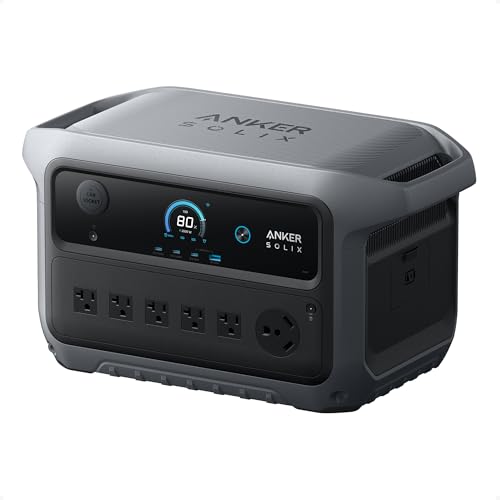 Anker SOLIX C2000 Gen 2Best Large-Capacity Station · 2,048 Wh, 2,400WBest for: The most capacity and output on this page |
|
$$$$ | Buy Now →Check current price |
Price key: $ under $50 · $$ $50–$100 · $$$ $100–$175 · $$$$ $175+. Prices change often; check Amazon for today’s price.
1. Anker SOLIX C1000 Gen 2: Best Overall
Anker’s SOLIX C1000 Gen 2 is a mid-size power station: 1,024 watt-hours of stored energy behind ten ports, with a rated 2,000 watts of output and a 3,000-watt peak. That output is high for its capacity, so it can handle appliances with a large startup draw, such as a microwave or a power tool, as long as you keep an eye on how quickly they empty the battery.
Day to day, the headline is recharge speed. Anker says HyperFlash charging refills it at 1,600 watts in 49 minutes, though you enable that mode in the Anker app. With solar, the listing says 600 watts of panels (60V max) can recharge it in 1.8 hours. For outages, Anker lists an under-10 ms UPS switchover, and names CPAP machines and laptops as the kind of equipment it is meant to keep running.
Anker also describes a TOU (time-of-use) mode in its app that manages charging and discharging around peak electricity rates, and says the battery keeps at least 80% capacity after 4,000 cycles, which it calls ten years of use. The listing puts the unit at 15.1 x 8.2 x 9.6 inches and 24.91 pounds, and the box holds the station, an AC charging cable, a quick start guide and a safety and warranty card.
It suits homeowners and renters who want one station that can run a modem, lights, a CPAP and kitchen gadgets through an evening outage, and who like the idea of topping it back up in under an hour once power returns.
Why we like it
- 49-minute full recharge (app mode)
- 2,000W rated output
- Sub-10 ms UPS switchover
Watch out for
The bullets don’t name the cell chemistry or offer an expansion battery, so check Anker’s spec sheet if either matters to you.
Key Specifications
| Type | 1,024 Wh, 2,000W AC |
|---|---|
| Capacity / output | 1,024 Wh / 2,000W (3,000W peak) |
| AC recharge | 49 min at 1,600W (app setting) |
| Solar input | 600W (60V max), 1.8 hr full charge |
| Listed size / weight | 15.1 x 8.2 x 9.6 in / 24.91 lb |
| Size | 15.1 x 8.2 x 9.6 in |
| Listed weight | 24.91 pounds |
| Warranty | 5 years |
| Model | A1763 |
| Seller | AnkerDirect |
| Best Sellers Rank | #2,250 overall; #21 in Generators & Portable Power (Oct 2026) |
Why We Recommend It
Output relative to size is the case for it. The listing promises “2,000W (3,000W peak) and 1,024Wh capacity” through 10 ports, more rated watts than the similar-capacity DELTA 3 (1,800W) and the Jackery 1000 v2 kit (1,500W). Only the larger C2000 Gen 2 beats it here.
Recharge speed is the second piece of evidence: “fully recharge at 1,600W” in 49 minutes, with the caveat “Enable it in the Anker app.” Anker also lists “under 10 ms UPS switchover” and names “CPAP machines and laptops.” Solar input tops out at “600W (60V max),” the highest stated solar figure on the page. Anker says the battery “still has at least 80% capacity” after 4,000 cycles.
AnkerDirect sells it, it ranks #21 in Generators & Portable Power and #2,250 overall, and the warranty field reads “5 years.” At 24.91 pounds and 15.1 x 8.2 x 9.6 inches, it’s a touch lighter than the DELTA 3 (27.56 lb). Gaps: no cell chemistry is named, and unlike the DELTA 3 there’s no expansion battery on the listing.
Pick it for an all-round 1 kWh station with high output. Skip it if you know you’ll want to add capacity later; the DELTA 3 is built for that.
Pros
- 2,000W output, 3,000W peak, per the listing
- Under 10 ms UPS switchover, per Anker
- Full recharge in 49 min at 1,600W (enabled in the app)
- 4,000 cycles to at least 80% capacity, per Anker
- Warranty field: “5 years”
Cons
- Bullets don’t name the battery chemistry
- No expansion battery mentioned on the listing
- Listed at 24.91 lb
- Fast-charge mode must be switched on in the Anker app
Best for: A household that wants about a kilowatt-hour of backup with high output, quick UPS switchover and the fastest wall recharge on this page.
2. EcoFlow RIVER 3: Best Compact Backup
EcoFlow’s RIVER 3 is the small end of the power station range: 245 watt-hours in a box EcoFlow says is 30% smaller than the industry average, at a listed 7.8 pounds. The title lists 550 watts of output. That is enough for the low-draw gear that matters most in an outage, such as a Wi-Fi router, phone chargers, an LED lamp and a laptop, rather than kitchen appliances.
EcoFlow builds the pitch around efficiency. The listing says its X-GaNPower technology delivers double the runtime for appliances under 100 watts and keeps noise under 30 dB at 1.5 feet. Recharging is quick: a full AC charge takes about one hour with a single cable and no separate adapter, or 2.6 hours with 110 watts of solar input.
For outages, the listing describes under-20 ms auto-switching UPS: leave your gear plugged into the RIVER 3 and it takes over the load when wall power fails. The LFP (lithium iron phosphate) battery is rated for 3,000-plus cycles. EcoFlow also cites X-Guard monitoring with more than 40 safety measures and IP54 battery protection, and describes the unit as waterproof, fireproof and drop-resistant; those are the brand’s own claims.
It suits renters, dorm rooms and anyone who mainly wants to keep communications running. It also makes a sensible second unit beside a larger station, for a bedroom or home office.
Why we like it
- Fits in a closet or bag
- One-hour wall recharge
- UPS mode for a router or modem
Watch out for
At 245 Wh it is a communications and lighting battery, not a refrigerator backup, and the warranty field gives no unit of time.
Key Specifications
| Type | 245 Wh, LFP |
|---|---|
| Capacity | 245 Wh, LFP |
| Output (title) | 550W |
| Recharge | 1 hr AC; 2.6 hr with 110W solar |
| Listed size / weight | 8.3 x 4.4 x 10 in / 7.8 lb |
| Size | 8.3 x 4.4 x 10 in |
| Listed weight | 7.8 pounds |
| Warranty | 2 |
| Model | EFR705; made by ECOFLOW |
| Seller | ECOFLOW Direct |
| Best Sellers Rank | #7,426 overall; #34 in Generators (Oct 2026) |
Why We Recommend It
Weight decides this one. At 7.8 pounds and 8.3 x 4.4 x 10 inches, the RIVER 3 is the lightest and smallest pick by a wide margin; the next lightest, the Jackery 500 v2, is listed at 13.3 pounds.
EcoFlow’s bullets promise “<20 MS Auto-switching UPS,” a “0-100% in 1 hour” wall charge with no adapter, and “2.6 hours with 110W solar input.” It claims “double runtime for appliances under 100W” and “less than 30 dB at a distance of 1.5 ft.” The LFP battery is rated for “3000+ times,” and the listing cites “IP54 battery protection.”
Capacity is the trade: 245 Wh is the smallest here, about half the Jackery 500 v2’s 512 Wh. By our math it would run a 20-watt router and modem for roughly 10 hours. ECOFLOW Direct sells it, and it ranks #34 in Generators and #7,426 overall. The warranty field reads only “2,” with no unit, so confirm the term with EcoFlow.
Communications backup in a small apartment is the sweet spot. Anyone hoping to save a fridge or run a CPAP all night with the humidifier on should look at the Jackery 500 v2 or a 1 kWh station instead.
Pros
- Lightest pick: 7.8 lb
- Full AC charge in 1 hour, per EcoFlow
- Under-20 ms UPS auto-switching
- LFP battery, 3,000+ cycles, per the listing
- Sold by ECOFLOW Direct
Cons
- Smallest capacity here: 245 Wh
- Warranty field reads only “2” (no unit given)
- Continuous AC rating not spelled out beyond the title’s 550W
- #7,426 overall, behind most picks
Best for: An apartment dweller or anyone who wants a light, closet-sized battery for the router, phones, a lamp and a laptop during short outages.
3. Jackery Explorer 500 v2: Best for CPAP Backup
Jackery’s Explorer 500 v2 sits between the small communication batteries and the kilowatt-hour stations. It stores 512 watt-hours, is rated for 500 watts with a 1,000-watt surge, and has two pure sine wave AC outlets. Jackery lists laptops, mini-fridges, cameras, phones and small appliances as typical loads.
For overnight use, three listing features stand out. It has a 10 ms uninterruptible power supply (UPS) mode for blackouts, plus a bypass charging mode that keeps plugged-in devices running from the wall while the station charges. Jackery says operating noise drops as low as 28 dB, which matters if it sits on a nightstand. And the built-in LED light gives you a way to see as soon as the room goes dark.
The LiFePO4 battery is rated for 6,000 charge cycles. Jackery also cites low self-discharge, only 5% after half a year in storage, and an energy-saving mode, both useful for a unit that may sit in a closet for months between storms. Recharging takes 52 minutes from 0 to 80% on a wall outlet, and the station also accepts solar panels (sold separately) and 12V car charging. A 16.4-foot extension cable comes in the box.
It suits CPAP users and anyone who needs one important device kept running through the night. Check your device’s power needs with its maker first.
Why we like it
- 10 ms UPS plus bypass charging
- Quiet enough for a bedroom, per Jackery
- Holds charge in storage
Watch out for
The 500-watt rating rules out coffee makers and microwaves, and the specs weight (13.3 lb) doesn’t match the bullets’ 14 lb.
Key Specifications
| Type | 512 Wh, LiFePO4 |
|---|---|
| Capacity / output | 512 Wh / 500W (1,000W surge) |
| AC outlets | 2 pure sine wave |
| Recharge | 0–80% in 52 min (AC); solar and 12V car supported |
| Listed size / weight | 11.8 x 7.6 x 9.5 in / 13.3 lb (bullets: 14 lb) |
| Size | 11.8 x 7.6 x 9.5 in |
| Listed weight | 13.3 pounds |
| Warranty | 5 year manufacturer |
| Model | JE-500A |
| Seller | Jackery Inc |
| Best Sellers Rank | #9,997 overall; #44 in Generators (Oct 2026) |
Why We Recommend It
Bedside fit is what earns it this slot. Jackery lists a “10ms Uninterruptible Power Supply (UPS),” a “Bypass charging mode,” and noise “as low as 28 dB,” the quietest operating figure stated on this page.
Storage behavior matters for a unit that waits months between outages. The listing cites “only 5% after half a year in storage” and a LiFePO4 battery “rated for 6,000 charge cycles,” the highest cycle rating here. Recharging runs “0% to 80% in just 52 minutes” on AC, and it accepts solar (sold separately) and 12V car charging.
The 512 Wh capacity is about double the RIVER 3’s 245 Wh. By our math, a 50-watt load would run about 8.7 hours. Jackery Inc sells it, the warranty field reads “5 year manufacturer,” and it ranks #44 in Generators and #9,997 overall. One mismatch: the specs list 13.3 pounds, while the bullets say “only 14 lbs.” Its 500W rating (1,000W surge) is the lowest stated continuous output on this page.
CPAP users who’ve confirmed their device’s draw with the maker are the natural buyers. If you need to run kitchen appliances too, a 1 kWh station is the better fit.
Pros
- 10 ms UPS with bypass charging, per the listing
- LiFePO4 rated for 6,000 cycles
- Runs as quiet as 28 dB, per Jackery
- 5% self-discharge after six months in storage, per Jackery
- Warranty field: “5 year manufacturer”
Cons
- 500W rated (1,000W surge): no kitchen appliances
- Solar panels sold separately
- Specs list 13.3 lb; bullets say 14 lb
- #9,997 overall
Best for: Someone who wants a quiet bedside battery for a CPAP, phone and lamp through the night, after confirming power needs with the device maker.
4. Jackery Solar Generator 1000 v2 With 200W Panel: Best Solar Generator Kit
Jackery sells this bundle as a “solar generator”: the Explorer 1000 v2 power station plus a 200-watt solar panel. The station stores 1,070 watt-hours and puts out 1,500 watts through three pure sine wave AC outlets, with a 3,000-watt surge peak. Jackery says that is enough for AC units, fridges and electric pots, and the station weighs a listed 23.8 pounds with a foldable handle.
Charging is the reason to buy the kit. On a wall outlet, Jackery says it defaults to a 1.7-hour full charge to protect battery health, or one hour if you enable emergency charging in the Jackery app before each charge. A 600W alternator charger (not included) can fill it in three hours. The included 200W panel can bring it to 80% in about six hours, according to the listing, so on a sunny day during a long outage you can put back much of what you used.
Ports include two USB-C, one USB-A, a DC car port and three AC outlets, and the listing describes 100W USB-C PD charging for laptops. The app also offers a 30 dB quiet overnight charging mode and an energy-efficiency mode. The LFP battery keeps over 70% of its original capacity after 4,000 cycles, according to Jackery.
It suits families in storm-prone areas who want backup that can recover between days without fuel, and who have a sunny yard, deck or window to set the panel in.
Why we like it
- Solar panel included
- 1,500W through three AC outlets
- Quiet overnight charging mode
Watch out for
The panel and station arrive separately, and the warranty field (2 years) doesn’t match the “5 Years of Coverage” in the bullets, so confirm terms with Jackery.
Key Specifications
| Type | 1,070 Wh, LFP, with 200W panel |
|---|---|
| Capacity / output | 1,070 Wh / 1,500W (3,000W surge) |
| Included panel | 200W solar (ships separately) |
| Ports | 3 AC, 2 USB-C, 1 USB-A, 1 car port |
| Listed size / weight | 8.82 x 12.87 x 9.27 in / 23.8 lb |
| Size | 8.82 x 12.87 x 9.27 in |
| Listed weight | 23.8 pounds |
| Warranty | 2 year manufacturer |
| Model | JE-1000D; made by Shenzhen Hello Tech Energy Co., LTD |
| Seller | Jackery Inc |
| Best Sellers Rank | #593 overall; #2 in Generators (Oct 2026) |
Why We Recommend It
Popularity leads the evidence: #2 in Generators and #593 overall, the strongest rank on this page. Jackery Inc sells the bundle, which pairs the Explorer 1000 v2 with a 200W solar panel.
The station delivers “1,500W AC output and a 3,000W surge peak” from 1,070 Wh. Charging options are the most detailed here: one hour “with emergency charging activated via the Jackery App,” a default “1.7 hours,” “3 hours with a 600W Alternator Charger,” or “80% in 6 hours using a 200W solar panel.” It’s the only pick that ships with a panel.
Two flags. The warranty field says “2 year manufacturer,” but the box contents list “5 Years of Coverage,” so check which applies. And the bullets give no UPS switchover time, unlike the Anker C1000 Gen 2 and Jackery 500 v2. At 23.8 pounds it’s slightly lighter than the Anker C1000 Gen 2 (24.91 lb), and Jackery notes the panel and station “are shipped separately.”
Storm-country households who want to recharge without fuel should start here. If seamless switchover for a sensitive device is the priority, the Anker C1000 Gen 2 lists it and this kit doesn’t.
Pros
- Best rank here: #2 in Generators, #593 overall
- Includes a 200W solar panel
- 1,500W AC, 3,000W surge
- 1-hour emergency charge (app); 1.7 hr default
- LFP: over 70% capacity after 4,000 cycles, per Jackery
Cons
- Warranty field says “2 year manufacturer”; bullet says 5 years of coverage
- Panel and station ship separately
- No UPS switchover time in the bullets
- 200W panel takes about 6 hr to reach 80%, per Jackery
Best for: A household planning for outages that last more than a day, which wants a solar panel in the same box as the battery.
5. EcoFlow DELTA 3: Best Expandable Mid-Size
EcoFlow’s DELTA 3 is a 1,024 watt-hour station rated at 1,800 watts, built to be the first piece of a larger system. The listing says it works with EcoFlow’s DELTA 3, DELTA Pro 3 and DELTA 2 Max battery packs to expand up to 5 kWh, and that the DELTA 3 Extra Battery is a third smaller and lighter than the older DELTA 2 Extra Battery.
Recharging combines inputs. With 1,500 watts of AC input and 500 watts of solar together, EcoFlow says it reaches a full charge in 56 minutes and 80% in 30 minutes. Day to day, it has enough outlets to run 13 appliances at once, and EcoFlow’s X-Boost lets resistive appliances (things that heat, like kettles or hair dryers) draw more than 2,600 watts continuously at reduced power.
The battery uses LiFePO4 (LFP) cells, which EcoFlow rates at 4,000 cycles to 80% and a ten-year lifespan for daily use. The listing also describes an IP65 battery pack with what EcoFlow calls triple protection: splash-proof, dust-proof and oil-proof. In the box you get the station, an AC charging cable, a user manual and what EcoFlow calls an exclusive 5-year customer service.
It suits homeowners who want to start with a manageable 1 kWh unit and add capacity over time as they learn what their fridge, sump pump or medical equipment really draws in an outage.
Why we like it
- Grows to 5 kWh
- Fast combined AC and solar charging
- Sold and shipped by Amazon
Watch out for
The listing doesn’t give a UPS switchover time, so don’t count on it for equipment that can’t tolerate a brief cut.
Key Specifications
| Type | 1,024 Wh, LiFePO4, expandable |
|---|---|
| Capacity / output | 1,024 Wh / 1,800W (title) |
| Expansion | Up to 5 kWh (per listing) |
| Recharge | 56 min full with 1,500W AC + 500W solar; 80% in 30 min |
| Listed size / weight | 15.7 x 8 x 11.2 in / 27.56 lb |
| Size | 15.7 x 8 x 11.2 in |
| Listed weight | 27.56 pounds |
| Warranty | 5 Year |
| Model | EF-DL-H10-3; made by EcoFlow |
| Seller | Amazon.com |
| Best Sellers Rank | #1,192 overall; #4 in Generators (Oct 2026) |
Why We Recommend It
Growth room sets the DELTA 3 apart: “expansion up to 5kWh with DELTA 3, DELTA Pro 3, and DELTA 2 Max battery packs.” That is the second-largest expansion ceiling here, behind the FridgePower’s 8,064 Wh.
Amazon.com sells it, and it ranks #4 in Generators and #1,192 overall, second only to the Jackery kit. EcoFlow lists “4000 cycles to 80%” for its LiFePO4 cells and an “IP65 battery pack.” Combining 1,500W AC and 500W solar, “a full charge is achieved in 56 minutes,” and “an 80% charge can be reached in just 30 minutes.”
Output is rated at 1,800W in the title, below the Anker C1000 Gen 2’s 2,000W at the same 1,024 Wh, and the listing says X-Boost “supports resistive appliances with power demands over 2600W.” The warranty field reads “5 Year.” It’s the heavier of the two 1 kWh stations at 27.56 pounds. The bullets give no UPS switchover time.
Homeowners who expect to scale up later get the most from it. Anyone who needs a guaranteed fast switchover should compare the Anker C1000 Gen 2.
Pros
- Expands up to 5 kWh with extra batteries, per EcoFlow
- Sold by Amazon.com
- #4 in Generators, #1,192 overall
- Full charge in 56 min with AC plus solar
- LiFePO4, 4,000 cycles to 80%; IP65 battery pack, per the listing
Cons
- No UPS switchover time in the bullets
- Heavier than the C1000 Gen 2 at 27.56 lb
- Expansion batteries cost extra
- X-Boost above 2,600W is for resistive appliances only
Best for: A homeowner who wants a 1 kWh station now and the option to grow toward whole-day backup later.
6. BLUETTI FridgePower: Best for Refrigerator Backup
BLUETTI’s FridgePower is a power station designed around one job: keeping a refrigerator running when the grid fails. It stores 2,016 watt-hours in LFP cells and puts out 1,800 watts, but the shape is what sets it apart. At 75 mm (about 3 inches) thick, it is built to slide into the gap beside or behind a fridge, or mount on a wall, and BLUETTI says it fits 99.65% of kitchen gaps.
Day to day, you plug the fridge into it and leave it. BLUETTI calls its UPS “DualGuard”: a 10 ms switch to battery when the power drops, and an automatic return to grid power if the FridgePower itself fails. Four UPS modes (Standard, PV Priority, Time of Use and Customized) cover solar and peak-rate setups. The app pushes severe weather warnings and starts fast charging automatically, and it works with Alexa and Google Home for voice battery checks.
Efficiency is the other claim. BLUETTI lists an ultra-low 4-watt standby draw and says it delivers 26% longer runtime than competitors of the same capacity. With BlueCell 200 expansion batteries it grows to 8,064 Wh, which BLUETTI says can keep a refrigerator running for up to four days. The 1,800-watt output can also run a sump pump, fish tank, chest freezer or kitchen appliances, per the listing.
It suits households that lose groceries to outages more than anything else and want a permanent, set-and-forget backup in the kitchen. Mounting hardware, leveling feet and an 8.2-foot charging cable are included.
Why we like it
- Slim enough to hide beside the fridge
- Weather-alert pre-charging
- Grows past 8 kWh
Watch out for
The warranty field is empty and the bullets give no recharge time, so ask BLUETTI for both before you buy.
Key Specifications
| Type | 2,016 Wh, LFP, slim wall-mount |
|---|---|
| Capacity / output | 2,016 Wh / 1,800W, LFP |
| Expansion | Up to 8,064 Wh (BlueCell 200) |
| UPS | 10 ms; Standard, PV Priority, Time of Use and Custom modes |
| Listed size / weight | 13.78 x 2.95 x 22.83 in / 41.9 lb |
| Size | 13.78 x 2.95 x 22.83 in |
| Listed weight | 41.9 pounds |
| Warranty | Not stated in listing |
| Model | FridgePower |
| Seller | Bluetti |
| Best Sellers Rank | #11,160 overall; #51 in Generators (Oct 2026) |
Why We Recommend It
Purpose sets it apart: BLUETTI calls it a “refrigerator battery backup” with an “Only 75mm ultra-slim design” that installs “behind fridge, on wall, or side cabinet.” No other pick is designed to live in the kitchen.
The UPS claim is the most detailed here: a “10ms switch to battery,” and “even if FridgePower fails, it auto-returns to grid power,” with four UPS modes. BLUETTI lists “4W standby power consumption” and expansion “up to 8064Wh with BlueCell 200,” the largest ceiling on the page, plus “Storm Alert” pre-charging and Alexa and Google Home support.
Now the gaps. The warranty field is empty, no recharge time appears in the bullets, and at 41.9 pounds it’s the heaviest pick, just above the Anker C2000 Gen 2 (41.67 lb). Bluetti sells it, and it ranks #51 in Generators and #11,160 overall, the weakest rank here. Its 2,016 Wh is slightly below the C2000 Gen 2’s 2,048 Wh, and 1,800W output is lower than that model’s 2,400W.
Fridge-focused households wanting set-and-forget backup are the audience. Shoppers who need a portable station to carry around should choose the Anker C2000 Gen 2.
Pros
- 10 ms UPS, auto-returns to grid power if it fails, per BLUETTI
- Expands to 8,064 Wh with BlueCell 200 batteries
- 75 mm slim body; freestanding or wall-mounted
- 4W standby draw, per the listing
- App pushes severe weather alerts and starts fast charging
Cons
- Warranty field empty
- Heaviest pick: listed 41.9 lb
- Weakest rank here: #11,160 overall
- Recharge time not stated in the bullets
Best for: A homeowner who wants a battery permanently parked by the refrigerator, with automatic switchover and room to add capacity.
7. Anker SOLIX C2000 Gen 2: Best Large-Capacity Station
Anker’s SOLIX C2000 Gen 2 is the biggest station on this page: 2,048 watt-hours, rated at 2,400 watts with a 4,000-watt peak. Anker says that is enough to run multiple appliances at once, including most window and RV air conditioners. Add an expansion battery and capacity reaches 4 kWh, according to the listing.
For outage planning, Anker leans on efficiency. The listing says it uses only 9 watts on standby and can power a dual-door fridge for up to 32 hours, or up to 64 hours with the expansion battery. Those are Anker’s figures; your fridge’s real draw depends on its age, size and how often the door opens.
Recharging is fast for the size. The listing claims a full charge in 58 minutes using AC and solar together, and lists six ways to recharge in all. On the road, Anker says 800W UltraFast alternator charging reaches 100% in three hours, eight times faster than a standard car socket. The unit measures 18.1 x 9.8 x 10.1 inches and weighs 41.67 pounds, which Anker calls 25% lighter and 29% smaller than similar products. The box includes the station, an AC charging cable, a quick start guide, a safety manual and a warranty card.
It suits homeowners who want one large battery that can carry a refrigerator, lights, a modem and a medical device through a long outage, and who can lift a 40-pound box or leave it in place.
Why we like it
- 2 kWh in one box
- 2,400W for big loads
- Fast combined recharge
Watch out for
At nearly 42 pounds it is a move-it-once unit, and the listing gives no UPS switchover time or cell chemistry.
Key Specifications
| Type | 2,048 Wh, 2,400W |
|---|---|
| Capacity / output | 2,048 Wh / 2,400W (4,000W peak) |
| Expansion | Up to 4 kWh (per listing) |
| Recharge | 100% in 58 min (AC + solar); 800W alternator charging |
| Listed size / weight | 18.1 x 9.8 x 10.1 in / 41.67 lb |
| Size | 18.1 x 9.8 x 10.1 in |
| Listed weight | 41.67 pounds |
| Warranty | 5 years |
| Model | A1783 |
| Seller | AnkerDirect |
| Best Sellers Rank | #6,188 overall; #30 in Generators (Oct 2026) |
Why We Recommend It
Raw size is the argument: “2,400W rated and 4,000W peak output” from 2,048 Wh, the highest output and capacity on this page. Anker says it can run “most window and RV A/Cs.”
Expansion is listed “Up to 4kWh,” and recharging reaches “100% in 58 Min” with AC and solar. For travel, “800W UltraFast Alternator Charging” claims a full charge “in 3 hours.” Anker cites “only 9W on standby” and a dual-door fridge for “up to 32 hours,” or 64 hours with an expansion battery; treat those as brand figures.
AnkerDirect sells it, the warranty field reads “5 years,” and it ranks #30 in Generators and #6,188 overall. At 41.67 pounds and 18.1 x 9.8 x 10.1 inches, it’s the bulkiest portable box here. The listing doesn’t name the battery chemistry, a cycle rating or a UPS switchover time; the FridgePower at least names LFP cells and a 10 ms UPS.
Large homes wanting maximum output in one portable unit should shortlist it. If automatic switchover for a fridge is the main job, the FridgePower documents that better.
Pros
- Largest capacity here: 2,048 Wh
- Highest output here: 2,400W, 4,000W peak
- Expands to 4 kWh, per Anker
- 100% in 58 min (AC and solar), per the listing
- Warranty field: “5 years”
Cons
- Listed 41.67 lb, nearly as heavy as the FridgePower
- Bullets don’t name the battery chemistry or cycle rating
- No UPS switchover time on the listing
- Fridge run-time claims (32 and 64 hours) are Anker’s own
Best for: A household that wants the most stored energy and output here, to run a fridge plus other essentials, or a window A/C, through a long outage.
How We Chose the Best Portable Power Stations
We kept only stations that were in stock and sold by Amazon.com or the brand’s own Amazon store, covered four brands (EcoFlow, Jackery, Anker SOLIX and BLUETTI), and compared what each listing states:
- Capacity (Wh): how much energy is stored, from 245 Wh to 2,048 Wh.
- Output (W): rated continuous watts and any surge or peak figure.
- Outage features: UPS or auto-switching time, only where the listing gives one.
- Recharging: wall, solar and car options, with the times each brand claims.
- Battery and build: chemistry as listed (LFP/LiFePO4 or not stated), cycle ratings, weight and size.
- Warranty and popularity: the warranty field and Amazon sales rank, with empty fields flagged.
Every pick lands in our top price tier ($$$$); no station that met our seller and stock rules fell into a lower one, so there is no true budget pick here.
Portable Power Station Buying Guide
Watt-Hours vs Watts: Capacity and Output
Watt-hours (Wh) tell you how much energy is in the tank; watts (W) tell you how much it can deliver at once. A station needs enough watts to start and run a device, and enough watt-hours to keep it running as long as you need. Surge or peak watts cover the brief jolt some appliances draw at startup. For a rough run time, by our math: Wh × 0.85 ÷ device watts = hours. The 0.85 allows for conversion losses. A 1,024 Wh station running a 100-watt load works out to about 8.7 hours by our math. Treat any result as an estimate, because real draw changes as appliances cycle on and off.
Best Portable Power Station for Home Backup
For outages, look for a UPS or auto-switching feature: plug your device into the station, plug the station into the wall, and it takes over when the power fails. Our listings state 10 ms (Jackery 500 v2, BLUETTI FridgePower), under 10 ms (Anker C1000 Gen 2) and under 20 ms (EcoFlow RIVER 3). The DELTA 3, Jackery 1000 v2 kit and Anker C2000 Gen 2 listings don’t give a switchover time. Pair your station with a weather radio so you know when storms are coming and can top up the battery first.
Best Solar Generator: Recharging When the Grid Is Down
A “solar generator” is a battery station paired with solar panels. Only the Jackery kit here includes a panel (200W), which the listing says brings the station to 80% in about six hours. Others list maximum solar input instead: 600W for the Anker C1000 Gen 2 and 500W combined with AC for the DELTA 3. Car charging is the backup when skies are gray; the Jackery 500 v2 supports 12V car charging and the Anker C2000 Gen 2 lists 800W alternator charging.
Best Power Station for CPAP and Medical Devices
Medical devices need a plan, not a guess. Ready.gov’s power outage guidance tells people to talk to their medical provider about a power outage plan for medical devices powered by electricity. Ask your device maker how many watts your CPAP draws, with and without the humidifier, and whether it can run on battery power. Then apply the formula: a device drawing 50 watts would run roughly 8.7 hours on the 512 Wh Jackery 500 v2 by our math. We make no medical claims for any station here.
Best Power Station for Refrigerator Backup
Fridges cycle on and off, so their average draw is far below their startup surge. Check the label or a plug-in meter for real figures. BLUETTI says the FridgePower can keep a refrigerator running for up to four days with expansion batteries, and Anker says the C2000 Gen 2 can run a dual-door fridge for up to 32 hours; both are brand claims. If your fridge averaged 150 watts, the 2,016 Wh FridgePower would last about 11.4 hours by our math. Ready.gov notes a closed refrigerator keeps food cold for about four hours, which is the window a station extends.
Best Battery Generator vs Gas: LFP, Weight and Expansion
LFP (LiFePO4) batteries are rated for thousands of cycles; the RIVER 3, Jackery 500 v2, Jackery 1000 v2, DELTA 3 and FridgePower listings name LFP or LiFePO4, while the two Anker listings don’t state chemistry. Weight runs from 7.8 pounds (RIVER 3) to 41.9 pounds (FridgePower). If you think you’ll want more capacity later, three listings mention expansion batteries: DELTA 3 (to 5 kWh), Anker C2000 Gen 2 (to 4 kWh) and FridgePower (to 8,064 Wh).
Power Station Safety: Carbon Monoxide, Batteries and Cords
The CPSC’s guide notes that carbon monoxide is produced by burning fuel. Battery stations burn none, which is why they can sit indoors where a gas generator never should. If you also own a gas generator, the CPSC’s carbon monoxide safety guide (CPSC-464) warns never to run one in the home, garage or crawlspace, and says opening doors and windows or using fans will not prevent CO build-up. The U.S. Fire Administration adds that portable generators belong outdoors in well-ventilated areas away from doors, windows and vents, and recommends CO alarms on every level of the home. See our carbon monoxide detector guide and, for gas units, the best generator cord for running power safely from outside.
Lithium batteries carry their own risks. The USFA’s battery fire safety page says to stop using lithium-ion batteries if you notice an odor, change in color, too much heat, change in shape, leaking or odd noises, to store them away from anything that can burn, and to keep them out of direct sunlight and hot cars. Charge your station where you can see it, follow the maker’s temperature limits, and never cover the vents.

Backup Power and Your Home Insurance
A power station can protect food, keep a sump pump or medical device running and keep you in touch during a storm, but it doesn’t change what your policy covers. Whether spoiled food, a failed sump pump or battery damage is covered depends on your policy, so ask your agent. Our Ohio homeowners insurance guide and renters insurance costs in Ohio are good places to start your questions.
Frequently Asked Questions
What is the best portable power station for home backup?
Our top pick is the Anker SOLIX C1000 Gen 2: 1,024 Wh, 2,000W output, an under-10 ms UPS switchover and a 49-minute full recharge (enabled in the app), per the listing. For fridge-first backup, the BLUETTI FridgePower and Anker C2000 Gen 2 offer about 2 kWh.
How long will a portable power station run a refrigerator?
It depends on your fridge’s average draw. By our math, multiply the station’s watt-hours by 0.85 and divide by the fridge’s average watts. A 2,016 Wh station and a fridge averaging 150 watts gives roughly 11 hours. Brand claims, like BLUETTI’s four days with expansion batteries, assume their own test conditions.
Can a power station run a CPAP all night?
Many can, but check with your device maker for its wattage and battery guidance first. As an example by our math, a CPAP drawing 50 watts would run about 8.7 hours on the 512 Wh Jackery 500 v2. Ready.gov advises talking to your medical provider about a power outage plan for electric medical devices.
Is a battery generator safe to use indoors?
Battery stations burn no fuel and have no exhaust, so they don’t create carbon monoxide the way gas generators do. Follow the maker’s charging and ventilation instructions, and keep lithium batteries away from anything that can burn, as the U.S. Fire Administration advises.
What is the best solar generator for outages?
The Jackery Solar Generator 1000 v2 kit includes a 200W panel and a 1,070 Wh station, and it has the best sales rank on this page (#2 in Generators). Jackery says the panel brings it to 80% in about six hours of sun.
The Bottom Line
For most homes, the Anker SOLIX C1000 Gen 2 is the best portable power station to start with: a kilowatt-hour of capacity, 2,000 watts of output, fast UPS switchover and a 49-minute recharge. Go smaller with the EcoFlow RIVER 3 for phones and the router, or the Jackery Explorer 500 v2 for a quiet bedside battery. The Jackery Solar Generator 1000 v2 kit adds a panel for long outages, the EcoFlow DELTA 3 grows to 5 kWh, and the BLUETTI FridgePower and Anker SOLIX C2000 Gen 2 bring about 2 kWh for refrigerator backup. Size it with the formula, and confirm medical device needs with the maker.
Planning for outages and wondering how your policy handles spoiled food or storm damage? Call Jeff Smith’s State Farm office at (740) 354-7747 or ask about a free coverage review.
Keep reading
More kitchen gear guides
- Magnets, Straps or Sliding Bars? Best Child Safety Locks for Cabinets, Drawers and Ovens
- Top of the Stairs or Bottom? Best Baby Gate for Stairs Picks, Sorted by Mount Type

- Feet on the Ground: The Best Roof Snow Rake by Reach, Blade Width and Rollers

- Grid Down, Lights Out: Best Flashlight for Emergencies, Headlamps and Lanterns
- Keep the Fridge and CPAP Running: Best Portable Power Station Picks, 245 Wh to 2 kWh
- Brace, Track Bar or Bolt-On Plate? The Best Door Security Bar for Hinged and Sliding Doors
- Guest Codes, Thumbprints and Matter: The Best Smart Lock for a Front Door Deadbolt

- Best Heat Tape for Water Pipes, Plus the Insulation and Fire Rules to Follow

- Best Gutter Guard Picks by Debris Type: Leaves, Pine Needles and Roof Grit